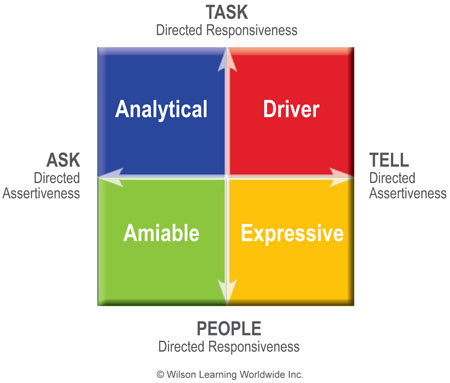
Communication Styles Driver Analytical Expressive Amiable
EQ dictates your life. Personality is a big part of EQ.
Nov 24, 2015 - In my experience, there tend to be four main personality types. I label them as analytical, driver, amiable, and expressive. Each of these personality types exhibit general characteristics, strengths, and weaknesses and need to be managed and communicated with in subtly different ways. These are examples of 4 different communication styles: Driver: the person who takes charge and wants solutions; Analytical: the person who values accuracy and details; Expressive: the idea person; and Amiable: the person who prioritizes relationships.
Mass Effect was built from the Unreal Engine (UE) 3 games engine, which allows many modifications by the user to enhance the in-game graphics and controls. Mass Effect's in-game configuration options have very little tweaking possibilities and only support basic graphic and key mapping. Mass Effect holds all of its main settings in a range of.ini (initialization) files found under your Documents and Settings User My Documents BioWare Mass Effect Config directory in Windows XP, or Users [User] Documents BioWare Mass Effect Config in Windows Vista. These.ini files can be viewed and edited using a text editor like Windows Notepad, but I recommend backing them up before changing any settings. Mass effect bioengine.ini file download. Welcome to /r/MassEffect. This subreddit is a forum for people who love the Mass Effect universe - the games, books, comics, and DLC. Join r/masseffect's officially endorsed Discord channel here! All rules are subject to moderator discretion.
The first step to improve EQ is to know one’s personality. There are many ways to measure personality, I will only mention one here: In their excellent book: “ The Art of Speed Reading People”, Pual and Barron Tieger listed “ The Four Type Dimensions” Extravert or Introvert – where do we get Energy: What energizes me most-Interacting with other people or being by myself? Sensor or Intuitive – how people perceive: The Forest or the Trees? Do I usually pay more attention to the facts and details or do I try to understand the connections, underlying meaning, and implications? Thinker or feeler – How people make Decision –- Do I make decisions more objectively, weighing the pros and cons, or based on how I feel about the issue, and how I and others will be affected by it? Judger or Perceiver – describes the very different ways people like to organize their world, and how they like to live their lives: Do I tend to make most decisions quickly and easily or does making decisions often make me anxious and unsure?
Would I rather have things settled and decided or be able to leave my options open, just in case something unexpected comes up? These 4 dimensions are all very good descriptors of personality type, and are all important in understanding people.
Of course, the combination of these 4 types results in 16 different variations. Whereas an expert is able to master the nuances, for regular Joe, it’s a bit overwhelming. If we ignore the Sensor/Intuitive and Judger/perceiver type ( for both of these are related to our decision making process), and roll them into thinker and feeler, we have a 2 by 2 matrix for personality quadrants.
Although it’s not as accurate, but it’s much easier and intuitive than 16 variations. Here is an analysis for the four basic personality styles: (from Janice & Joseph Lukas) the four basic personality styles Before looking more closely at each of the four basic personality styles, it’s important to note that what follows are generalized, simplified descriptions of behaviors and attributes.
It’s best to view the descriptions of the different personality styles as a sort of “shorthand” that provides useful, but incomplete, information about any individual. Human beings are extraordinarily complex, and no one is exclusively one temperament or type. While everyone is likely to have a dominant type or style, that style is augmented by a mixture of the other types and their traits and is often dependent on environment and circumstance. Also, no one personality style is “best”; each can be successful, and each has its merits as well as its drawbacks. The Analytical Personality The Analytical personality falls in the quadrant formed by the boundaries of Introvert/Thinker. Individuals in this quadrant are generally described as being logical, thorough, serious, systematic, prudent, cautious, and compliant. This personality type emphasizes working conscientiously to ensure quality and accuracy.